
Sticker stories · Part 1 · 1880 – 1994
Where does the word “meme” come from?
It started in a 1976 book about genes — decades before anyone put a caption on a cat photo.
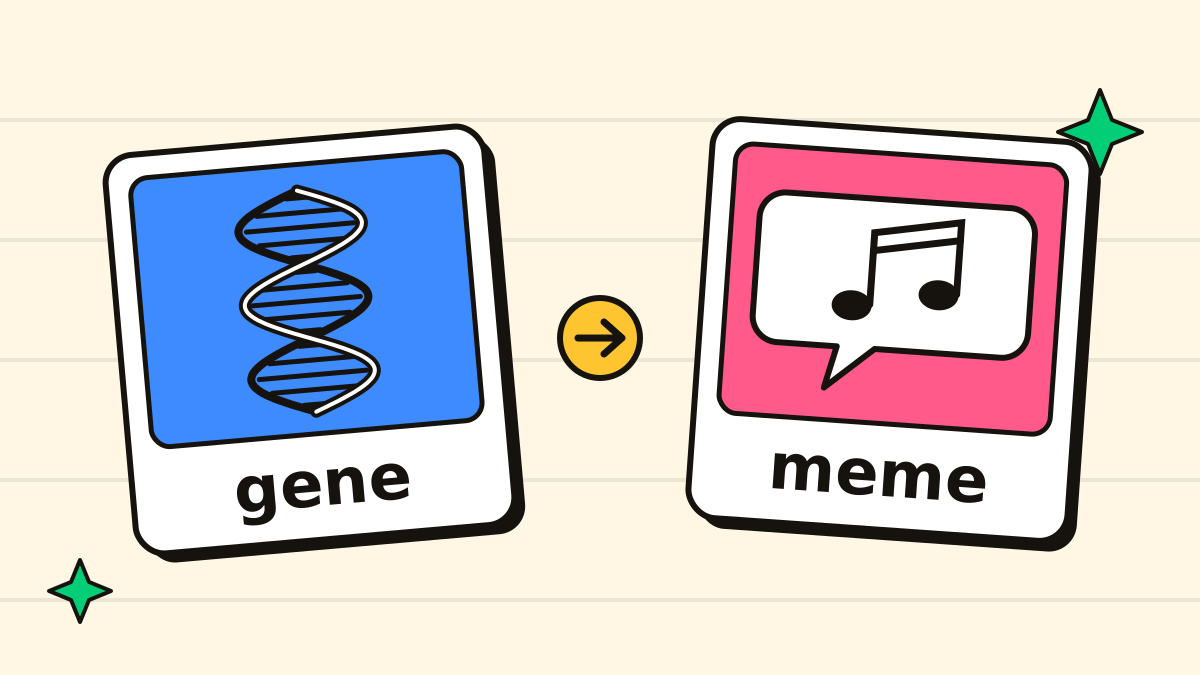
Today a meme is a picture with a caption, a reaction GIF, a sticker you send instead of typing a reply. But the word is older than the web, and it was not invented by anyone making jokes online. It was invented by an evolutionary biologist who needed a name for something that did not have one yet.
A word invented in a book about genes
In 1976 Richard Dawkins, a zoologist at Oxford, published The Selfish Gene. Most of the book is about biology. Its central idea is that evolution makes the most sense from the point of view of genes: pieces of information that are copied from one generation to the next, where the versions that get copied best become more and more common.
In the book’s last chapter, chapter 11, Dawkins asks a bigger question. Is the gene the only thing that works like this? He pointed to human culture. Tunes, catchphrases, fashions, ways of building arches — all of them pass from person to person by imitation. They get copied, they change a little on the way, and some spread while others disappear.
That is the same pattern as genes, only much faster and without any chemistry. Dawkins wanted a word for it — for, as he put it, “a unit of cultural transmission, or a unit of imitation.”
How the word was built
He started from Greek. Mīmēma means “something imitated”; it shares a root with mime and mimic. That gave him mimeme. But he wanted a single syllable that sounded like gene, so he cut it down to meme.
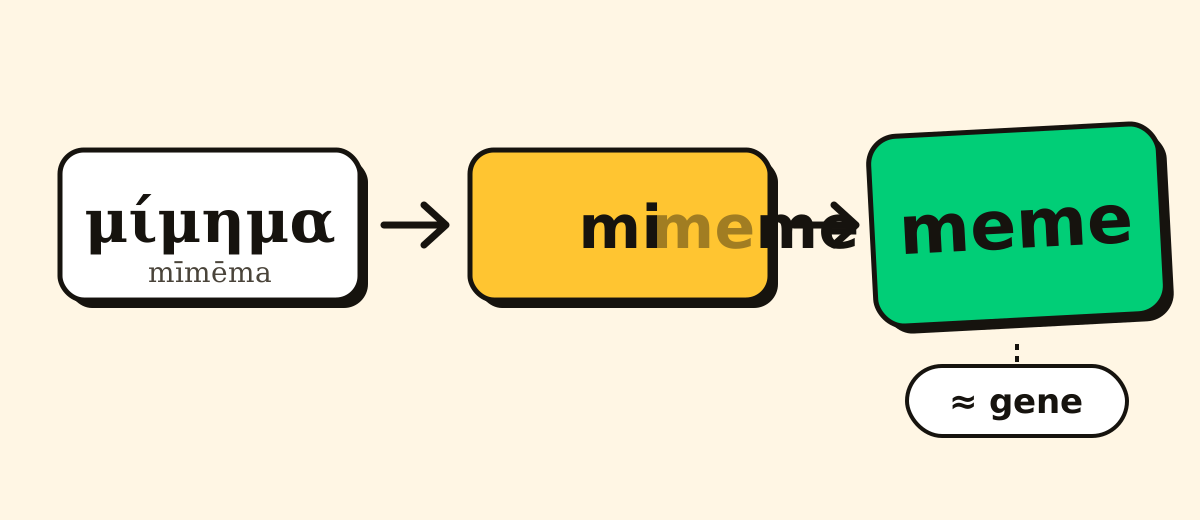
He added that you could also hear memory in it, or the French word même, “same”. And he said how to pronounce it: to rhyme with “cream”. Not “may-may”, not “mem” — one syllable, meem.
What makes something a meme?
Dawkins’s point was not that memes are funny. It was that some ideas behave a little like living things:
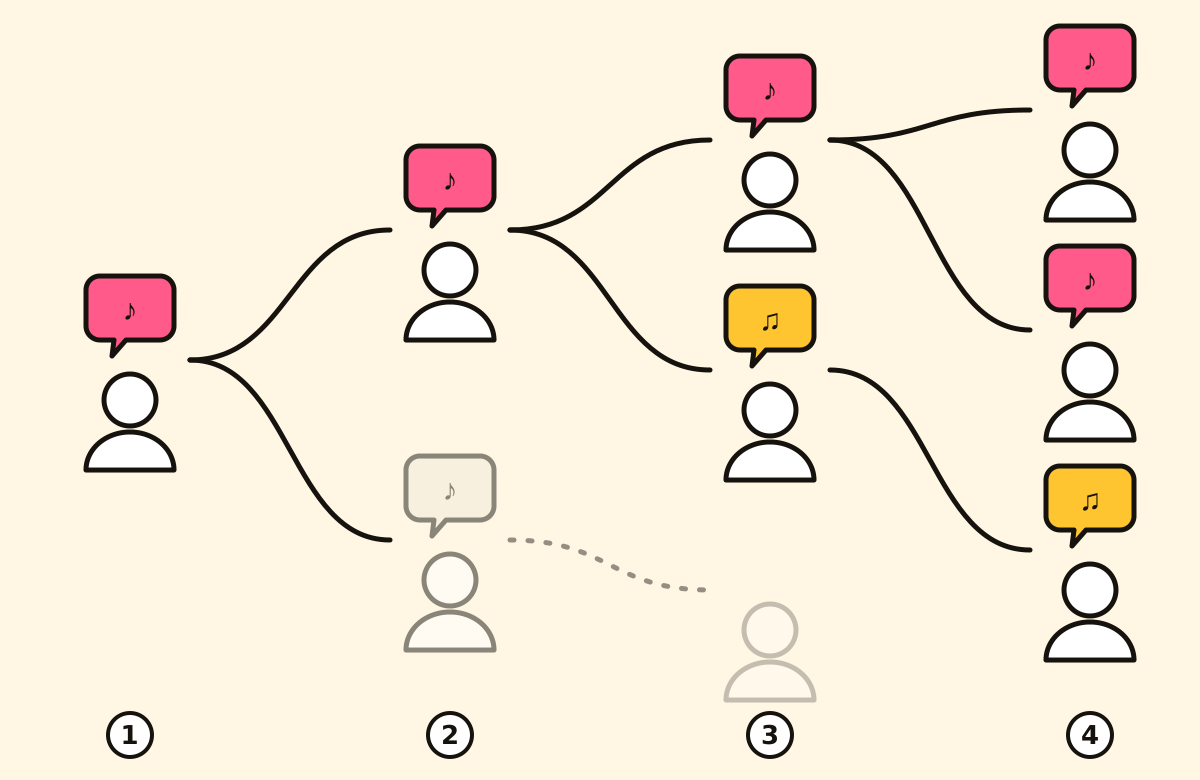
- They get copied. You hear a phrase and repeat it; someone hears you and does the same.
- The copies are not perfect. People mishear, shorten, remix and exaggerate, so every copy is slightly different.
- Some versions win. There is only so much attention to go around. The versions that are easier to remember or more fun to pass on spread; the rest fade away.
Copy, change, compete — that is all it takes. By this definition a joke, a dance move or a way of folding a paper plane is a meme. So is a sticker.
Not a completely new idea
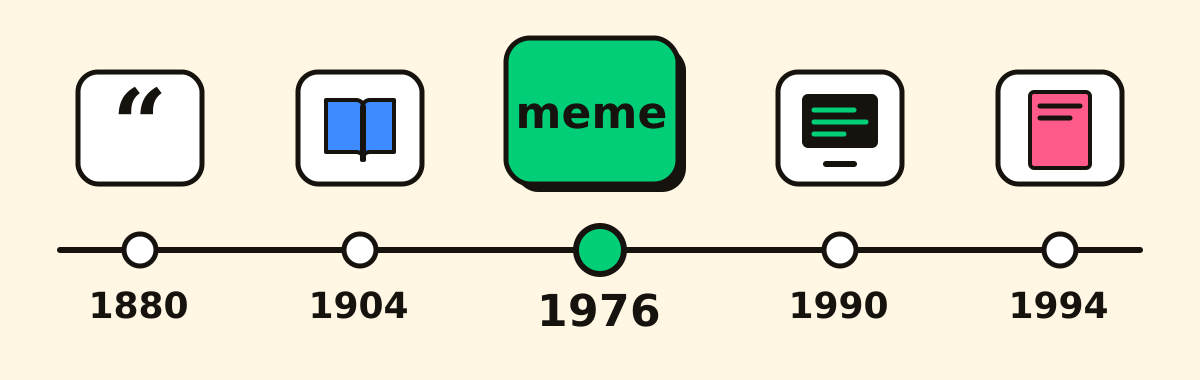
Dawkins never claimed to be the first to think this way. As early as 1880 the biologist Thomas Henry Huxley wrote that “the struggle for existence holds as much in the intellectual as in the physical world.”
There is even an older word that looks surprisingly similar. In 1904 the German biologist Richard Semon published Die Mneme (it appeared in English in 1924), using mneme for the traces that experience leaves behind in memory. It is a different idea, but the resemblance is often pointed out. What Dawkins added was the comparison with genes — and a short, catchy word that made the idea easy to pass on. Fittingly, the word then spread like a meme.
From a science idea to the internet
For years “meme” stayed mostly in science and philosophy. A small academic field called memetics tried to turn it into a proper theory: a Journal of Memetics ran from 1997 to 2005, and the psychologist Susan Blackmore published The Meme Machine in 1999.
The jump to the internet came from a lawyer. In 1990 Mike Godwin noticed that long arguments on Usenet — the discussion boards of the early internet — kept ending with someone being compared to Hitler or the Nazis. He introduced a rule of his own, now known as Godwin’s law, as what he called an experiment in memetics. In October 1994 he wrote about it in Wired, in an essay titled “Meme, Counter-meme”.
Online, the word found its natural home. Early internet culture was made of exactly what Dawkins had described: jokes, pictures and phrases copied from one forum to the next and changed along the way. Over the following years “meme” came to mean, above all, funny images and videos that spread online. Dawkins himself later called internet memes a “hijacking of the original idea” — a hijacking that rather proves his point, since the word changed as it was copied, just as a meme should.
So what is a meme?
In Dawkins’s sense: anything that is copied from one mind to another, changes a little as it goes, and survives for as long as people keep passing it on. A cat picture with a caption is one kind. So is a catchphrase, a dance, a tune you cannot stop humming — and every sticker you forward to a friend.
Next in this series: what memes looked like before the internet, from a cartoon face drawn on walls during the Second World War to office jokes passed around on photocopies.
Sources
- Richard Dawkins, The Selfish Gene, Oxford University Press, 1976 — chapter 11
- Mike Godwin, “Meme, Counter-meme”, Wired, vol. 2 no. 10, 1 October 1994
- Wikipedia — Meme
- Wikipedia — The Selfish Gene
- Wikipedia — Internet meme
- Wikipedia — Godwin’s law