
Sticker stories · Part 1 · 1940s – 1970s
What did memes look like before the internet?
Long before the word went online, a big-nosed doodle and a photocopied joke were already spreading the same way memes do.

The word meme is only about fifty years old — the last story in this series traced it to a 1976 book about genes. But the thing the word describes is much older. Long before anyone put a caption on a photo, jokes and drawings were already being copied from person to person, changed a little on the way, and passed on for as long as people found them funny. All you need is a copier, and the copier does not have to be a computer. It can be a wall, a typewriter, or the machine down the office hall.
Here are three memes from the age of chalk and paper.
The soldier who got everywhere
If you have seen a bald little man with dot eyes and a long nose drooping over a wall, gripping the top with his fingers, you have met Kilroy. During the Second World War American servicemen chalked the doodle and the words “Kilroy was here” wherever they went. Half the joke was where it turned up: on beaches before the troops landed, inside sealed ship compartments, in places nobody should have been able to reach.
Where it started is genuinely disputed — stories place the phrase as early as the late 1930s, and none of them can be fully pinned down. The most repeated explanation belongs to James J. Kilroy, a shipyard inspector at the Fore River Shipyard in Quincy, Massachusetts. Riveters there were paid by the rivet, and an inspector’s chalk tick could be rubbed out so a batch got counted twice; to stop that, Kilroy marked what he had checked with “Kilroy was here” in hard-to-erase crayon. Painting the insides of warships was low priority in the rush to launch them, so his marks sailed off to war in front of thousands of troops. In 1946 the American Transit Association ran a contest to settle the mystery; more than forty men claimed the name, and James Kilroy was the one the shipyard could vouch for. The Oxford English Dictionary, for its part, still just calls Kilroy “the name of a mythical person.”
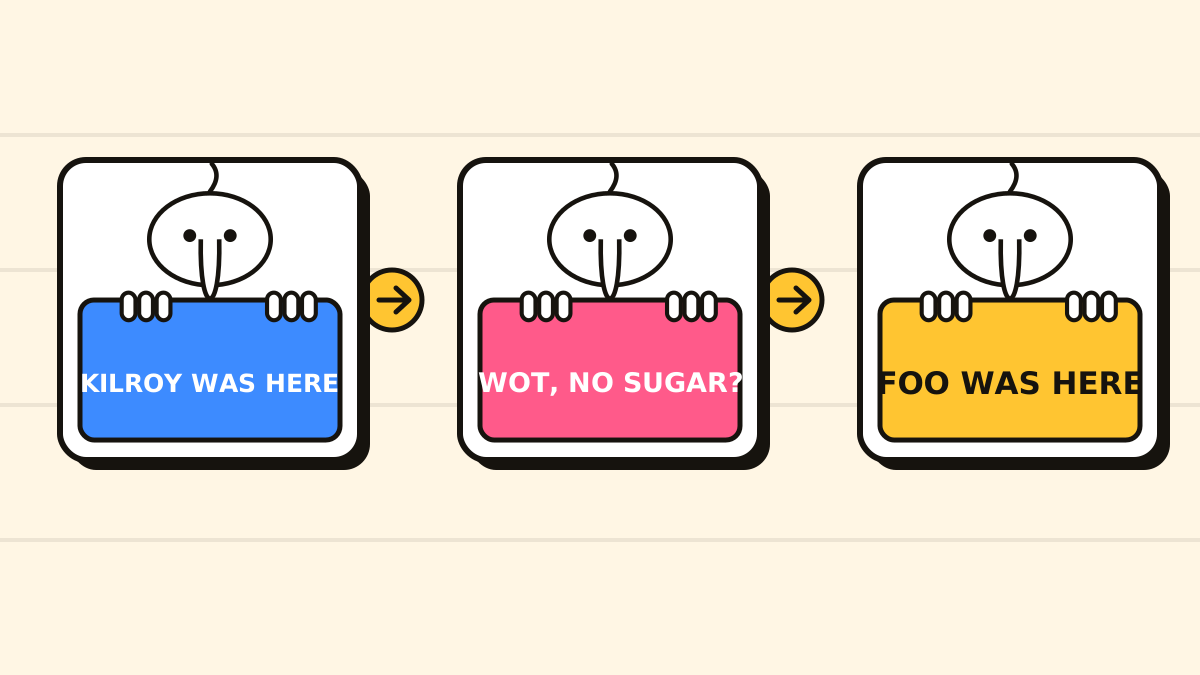
The same face, a hundred captions
The drawing and the slogan did not always travel together. In Britain the very same peeking face was known as Mr Chad, and instead of a name he complained about rationing: “Wot, no sugar?”, “Wot, no bread?”, “Wot, no tea?” — whatever was short that week. Chad may have been sketched by a British cartoonist as early as 1938; Life magazine reported in 1946 that the RAF and the army each wanted to claim him, but agreed he had first shown up around 1944. Australia, meanwhile, had Foo (“Foo was here”), which some trace all the way back to the First World War — though that claim is one of the shakier ones.
At some point during the war the British doodle and the American phrase simply merged, the face appearing above the words. And the character kept picking up new names as it spread — Smoe, Clem, Private Snoops, and later Overby in Los Angeles. That is exactly the three-step pattern the last story described: it was copied (soldier to soldier, wall to wall), the copies changed (new words, new names), and the catchiest versions won while the rest were forgotten. Nobody planned it. It behaved like a meme because that is simply what a good doodle does when a lot of people pass it around.
Jokes that traveled on paper
Walls were not the only network. Long before “forward this to ten friends”, there were chain letters — notes that promised luck, or money, if you copied them on and sent them to others. In 1935 a money chain letter known as “Send-a-Dime” swept across the United States and briefly buried post offices in mail. The instruction at the bottom was the whole trick: make copies and pass it on.
Then offices got photocopiers, and a new kind of folklore appeared: cartoons, fake memos and silly lists that spread desk to desk and building to building. Folklorists gave it a name — xeroxlore, coined by Michael J. Preston in 1974, also called photocopylore. Two of them, Alan Dundes and Carl Pagter, gathered a whole collection in a 1975 book with a very office-y title, Work Hard and You Shall Be Rewarded. The telltale sign was decay: each copy of a copy came out a little blurrier than the last. And because a photocopier is easy to abuse, people did — whiting out a name and typing in a colleague’s, swapping the punchline, making the joke local before sending it on again.

So were they memes?
By the definition from the last story — copied, changed on the way, and kept alive only as long as people pass it on — yes, all three qualify. Kilroy, Mr Chad and Foo were one doodle mutating across armies and countries. Chain letters were self-copying instructions. Xeroxlore was reaction images with the reactions typed in, spreading through the one machine every office had. None of them needed the internet.
So the internet did not invent the meme. Walls, letters and photocopiers had been copying, garbling and spreading jokes for decades. What the internet added was a faster copier — and, soon, a keyboard trick that turned punctuation into a face.
Next in this series: who typed the first :-), and how a sideways smiley became a meme of its own.
Sources
- Wikipedia — Kilroy was here
- Wikipedia — Faxlore (xeroxlore / photocopylore)
- Wikipedia — Chain letter
- Alan Dundes & Carl R. Pagter, Work Hard and You Shall Be Rewarded, American Folklore Society, 1975
- Michael J. Preston, “Xerox-lore”, Keystone Folklore, 1974
- “Wot! Chad’s Here”, Life magazine, 18 March 1946