
Sticker stories · Part 2 · 1982 – 1986
Who typed the first :-) ?
On one day in 1982 a computer scientist typed three characters as a throwaway idea — and made a face that outlived the machine he typed it on.
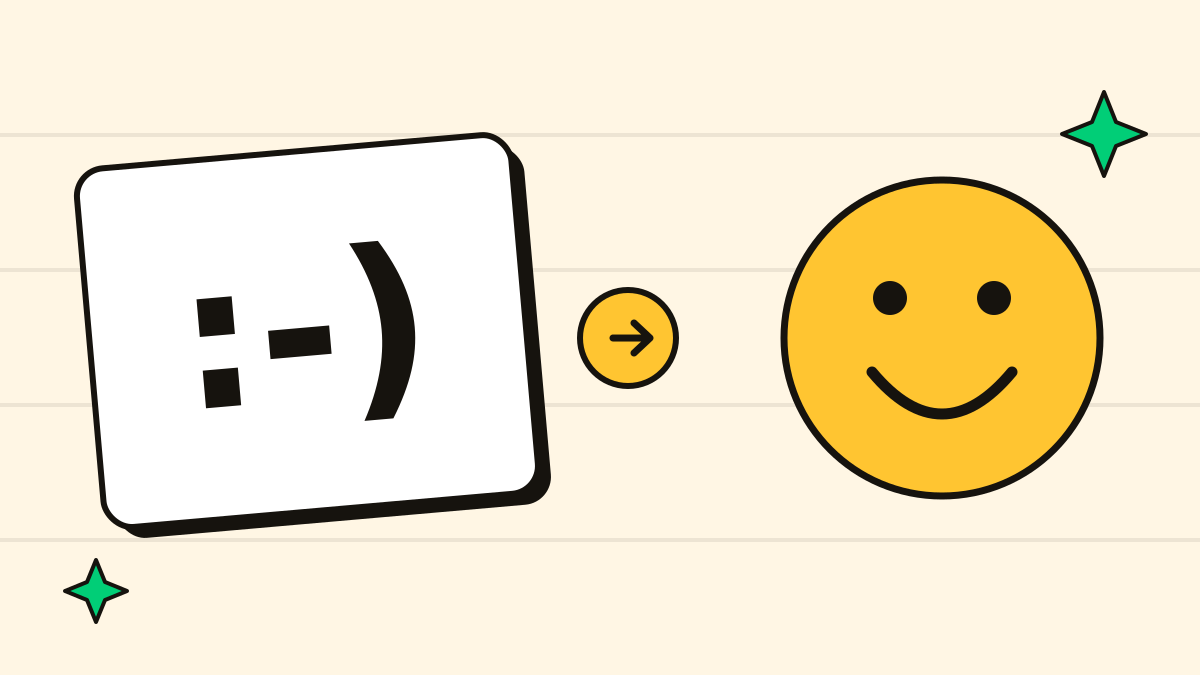
The last story ended with a promise: that soon after the war-era doodles and photocopied jokes, a keyboard trick would turn punctuation into a face. This is that trick. On one specific day in 1982, a computer scientist typed three characters as an offhand suggestion in an online discussion — and accidentally made a tiny meme that is still with us.
A joke that got mistaken for a warning
In the early 1980s the computer science department at Carnegie Mellon University ran busy online bulletin boards — “bboards”, a forerunner of newsgroups where faculty, staff and students argued about everything from parking to politics. Plenty of posts were jokes. The trouble, as Scott Fahlman later remembered, was that in plain text a sarcastic remark had no tone of voice: a few readers would miss the joke and fire back long, serious replies, which pulled in more people, until the original thread was buried. In one case a humorous line was read as a genuine safety warning.
So people started suggesting — half seriously — that jokes should be marked. In the middle of that discussion, on 19 September 1982, Fahlman proposed a solution that the plain ASCII terminals of the day could handle:
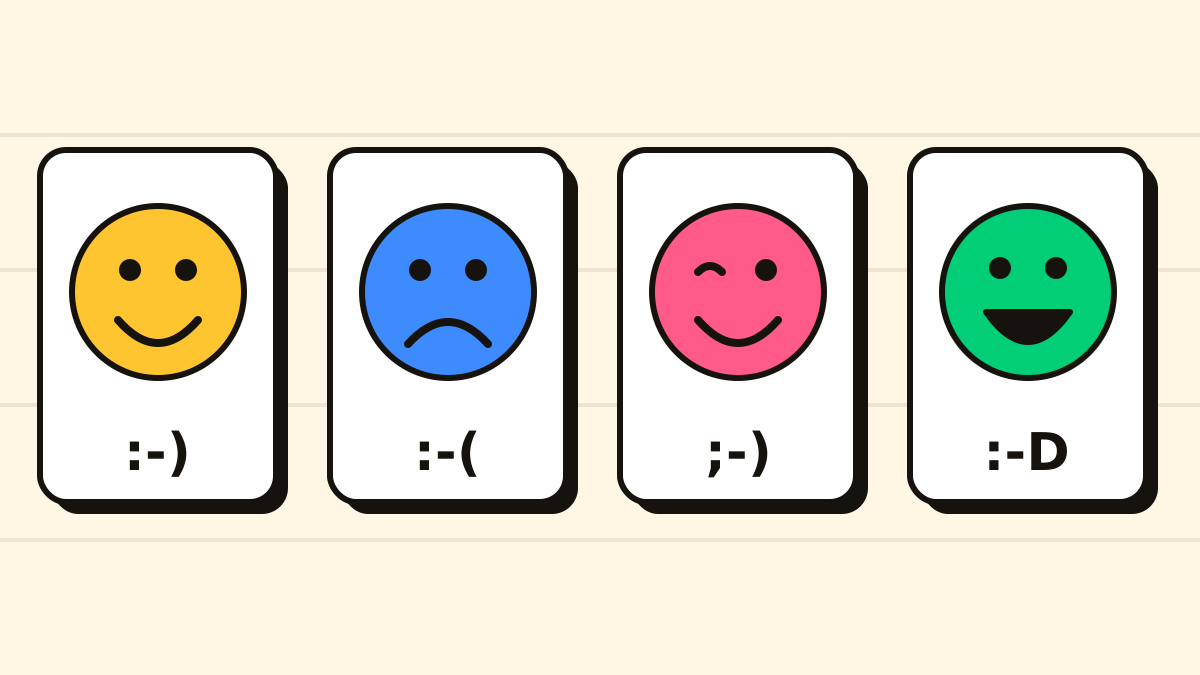
I propose the following character sequence for joke markers: :-)
Read it sideways. In the same post he offered :-( too — at first to mark messages meant seriously, though that one quickly drifted into standing for displeasure. The idea caught on around Carnegie Mellon within weeks and spread to other universities over the primitive networks of the time.
The message that was lost, then found
Fahlman never kept a copy — it hadn’t felt like a big deal. For nearly twenty years the original post was simply gone. Then, in 2001–2002, Microsoft’s Mike Jones sponsored what Fahlman calls the “Digital Coelacanth Project”: Jeff Baird and the CMU facilities staff dug through ancient backup tapes, found a drive that could still read them, and recovered the actual message — pinning the smiley’s birthday to 19 September 1982, just in time for its twentieth anniversary.
Fahlman is careful about the claim. He believes he came up with the glyph and the “turn your head to one side” idea on his own, but he doesn’t insist he was the very first human ever to type it. People have told him that teletype operators, or relatives writing private letters, used something similar long before 1982; it is, he admits, “a simple and obvious idea.” Years earlier the novelist Vladimir Nabokov had even wished aloud for “a special typographical sign for a smile — some sort of concave mark, a supine round bracket.” What makes Fahlman’s version matter is not that it was first, but that it was the one that spread — exactly what a meme has to do.
Meanwhile, in Japan: a face you don’t tilt
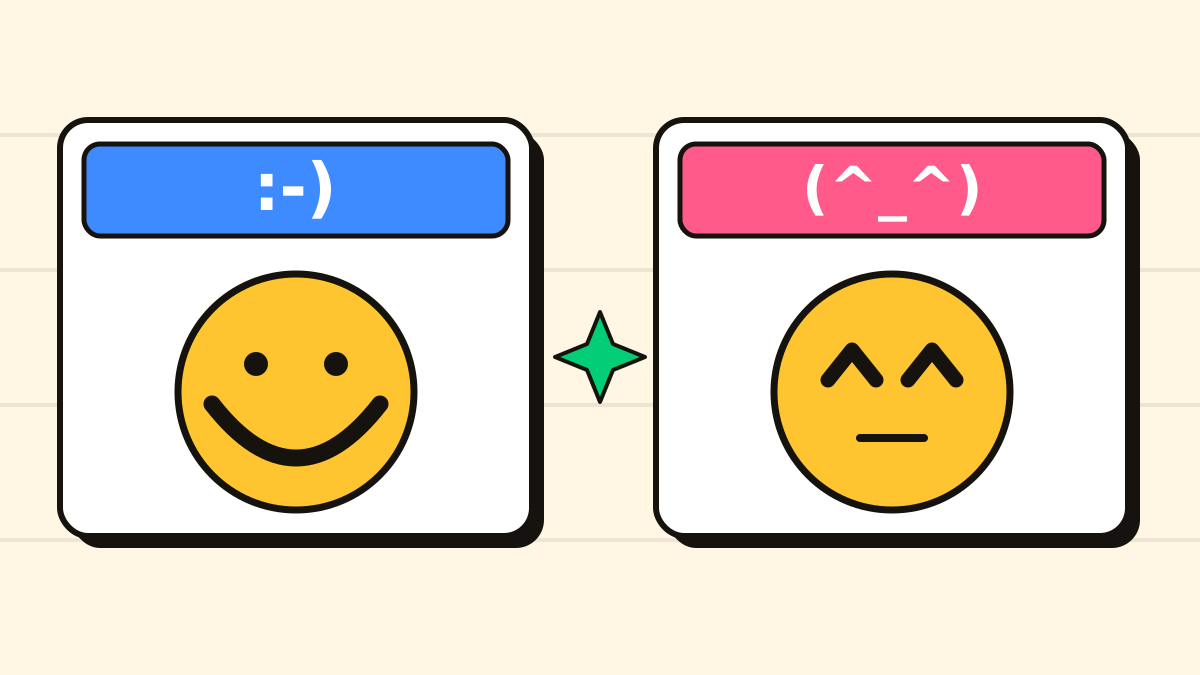
Around the same time, on the Japanese online service ASCII NET, a different kind of face was taking shape — one you read the normal way up, with no head-tilt at all: (^_^). These are kaomoji, literally “face characters”, and Yasushi Wakabayashi is credited with the original (^_^) in 1986.
The two styles solved the same problem from opposite ends. Western emoticons are read sideways and let the mouth do the work: :-) versus :-(. Kaomoji stay upright and let the eyes do the work: the parentheses are the face, the middle character is the mouth, and you change the eyes to change the feeling — (^_^) happy, (T_T) in tears. And where the American smiley was born among computer scientists, kaomoji spread through manga fans and, especially, young people, carried along by a kawaii — cuteness — sensibility.
Why a face made of punctuation stuck
By the definition from the earlier stories — copied, changed on the way, kept alive as long as people pass it on — the typed smiley is a textbook meme. :-) was copied from bboard to bboard and campus to campus, it changed into a whole zoo of variants (a wink, a noseless :), an open-mouthed gasp, even little portraits of Santa or the pope), and the few genuinely useful faces won while the rest were forgotten. Kaomoji did the same thing in parallel on the other side of the world.
Both also pointed in the same direction. Once chat programs began quietly swapping :-) for a little yellow picture, the typed face was already turning into a drawn one — the road that leads to the emoji, and eventually to the sticker you tap today. A face you can build from a keyboard is about as easy to copy as an idea gets. No wonder it behaved like a meme.
The smiley gave online writing a tone of voice. But a marker for “this is a joke” is a small thing next to what came next: a word for the jokes themselves. Around the same years, an argument on the early internet was about to hand us exactly that.
Next in this series: how a lawyer’s rule about online arguments became a deliberate experiment in memes — and gave us the phrase “internet meme”.