
Sticker stories · Part 3 · 2013 – 2022
How stickers went global
Asia proved stickers worked. Then, one by one between 2013 and 2021, every big messaging app added its own — and because there was no shared standard, each had to reinvent the pack, the store and the format.
The last story ended on a catch. Stickers had conquered Asia, but they were an app feature, not a standard like the Unicode behind emoji. There was no shared sticker format the way there is a shared code behind an emoji. So when the rest of the world’s apps wanted stickers, each had to build the whole thing again from scratch — its own packs, its own store, its own file format. This is the story of that scramble, and of how a still picture learned to move.
Everyone builds their own
Remember the difference from the last story: emoji are standard, stickers are not. An emoji works everywhere because every device agreed on the code point. A sticker works only inside the app that made it, because a sticker is just an image file the app knows how to send — and every app made different choices about size, format and how you would get a pack in the first place. That single fact shaped the next decade: not one global sticker system, but a dozen parallel ones.
The platforms fall in line
Once LINE had shown the money and the love, adoption was steady and worldwide:
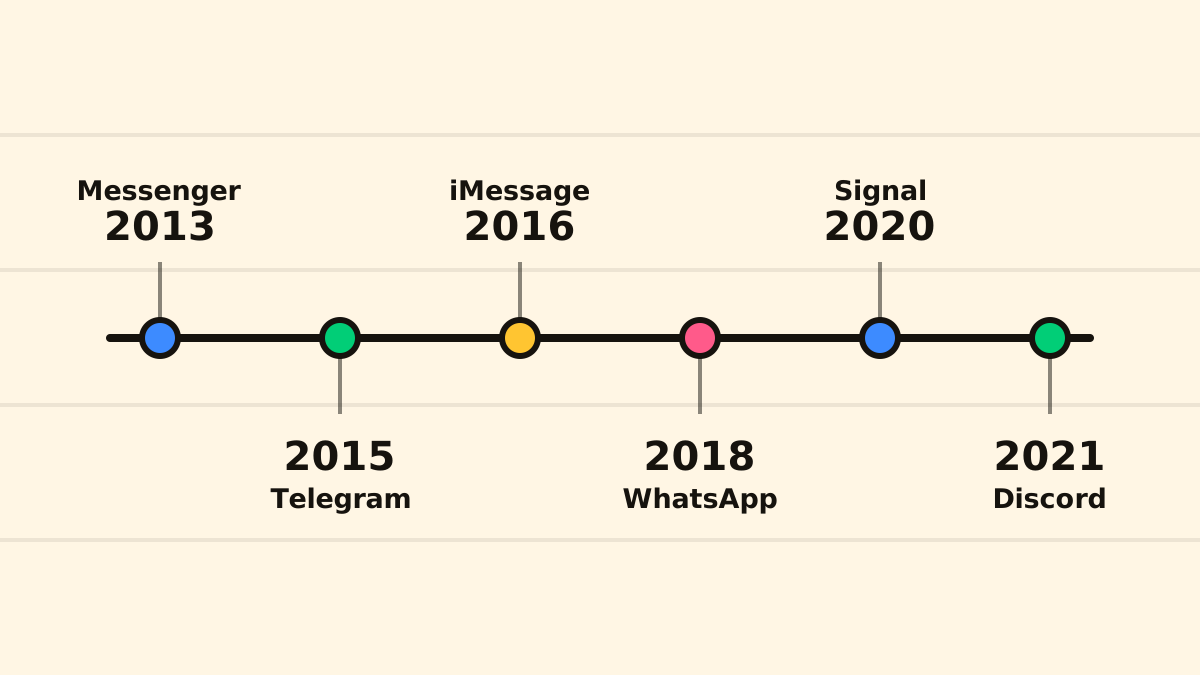
- Facebook Messenger added a sticker store in 2013, the first big Western app to take the idea mainstream.
- Telegram opened a full sticker platform in 2015 — and, as we will see, opened it wider than anyone.
- iMessage joined in 2016, when iOS 10 added an App Store inside Messages, with sticker packs (and, later, personalised Memoji).
- WhatsApp — the biggest messenger of all across much of the world — finally added stickers in 2018.
- Signal brought them in 2020, and Discord in 2021.
Telegram opens the door widest
One platform deserves singling out. When Telegram added stickers in 2015, it did something closer to LINE’s Creators Market — but free and instant. Through a simple robot assistant, anyone could upload images, bundle them into a pack and get a shareable link, with no fee, no approval queue and no store gatekeeping. Send someone the link and they could add the pack in a tap.
That openness made Telegram a natural home for meme culture and fan art, and it is why so much sticker experimentation happens there. It is also, to be transparent, the one platform where a website like this one can build a finished, installable pack for you end to end — precisely because Telegram left the door open. Everywhere else, more of the work has to happen inside the app.
From still to moving
The other half of “going global” was technical: stickers learned to move, and the industry never agreed on how. It is worth knowing the cast of formats, because they explain a lot of the friction:
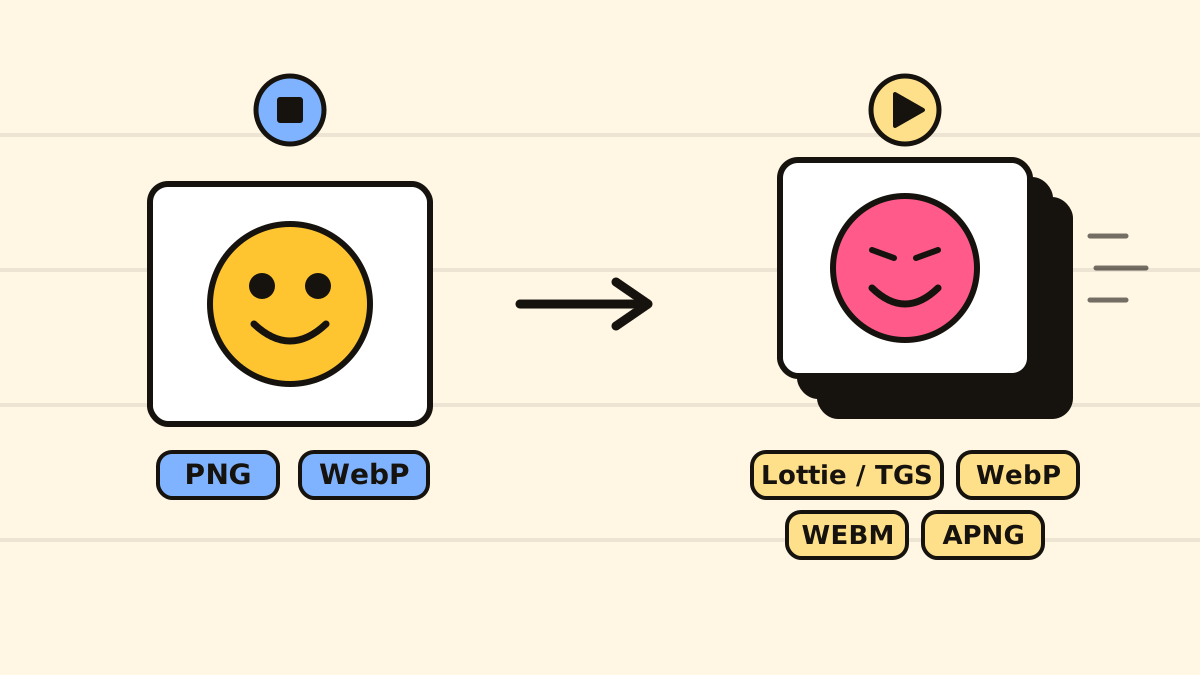
- Still stickers are usually WebP (Telegram and WhatsApp both settled on 512×512 WebP) or plain PNG — a flat image with the transparent background we met in the GIF story.
- Animated stickers split three ways. Telegram’s animated stickers use TGS, a tiny compressed vector format (a compacted form of Lottie) that stores the drawing as instructions, not pixels, so a moving sticker can be just a few kilobytes. WhatsApp animates with animated WebP. Discord and Signal lean on APNG. And for true video, Telegram added WEBM (VP9) video stickers.
So the same phrase — “animated sticker” — can mean a vector file, a raster loop or a short video, depending entirely on which app you are in. There is no single right answer, only per-platform rules.
The price of having no standard
All of this convenience came at a hidden cost that emoji never paid. Because there is no Unicode for stickers, a pack you love in one app cannot simply move to another; the sizes differ, the animation formats differ, the pack files differ, and each store has its own rules for what it will accept. Making “one pack for everywhere” is not a single job — it is a different job per platform, which is exactly why tools exist just to translate a set of images into each app’s particular idea of a sticker.
Fragmentation is the tax on freedom. Emoji chose a standard and got universality, at the cost of a fixed set. Stickers chose openness and got infinite variety, at the cost of ever working the same way twice.
Digital stickers now reach almost everyone on earth, in a dozen incompatible formats. But the idea of a sticker — a little picture you peel off and place to say “this is mine, this is me” — is far older than any phone. Before the final chapter, it is worth a short detour into where that idea really began: on paper, a hundred years ago.
Next in this series, a side trip: before pixels, a century of paper stickers — self-adhesive labels, collectors’ albums and scratch-and-sniff.