
Sticker stories · Part 3 · 2011 – 2014
Why were chat stickers born in Asia?
Emoji gave the world a fixed set of tiny faces. Asia wanted something bigger — a whole illustrated character as a message — and built it first, starting with a messaging app born in the months after a disaster.
The last story left emoji as a triumph with a ceiling: a shared, standard, but fixed set of a few hundred tiny pictures, the same for the whole planet. Almost as soon as that ceiling existed, people wanted to go over it — to send a bigger, richer, more personal picture. The answer wasn’t a new emoji. It was the sticker, and for reasons worth unpacking, it was born in Asia.
A sticker is not an emoji
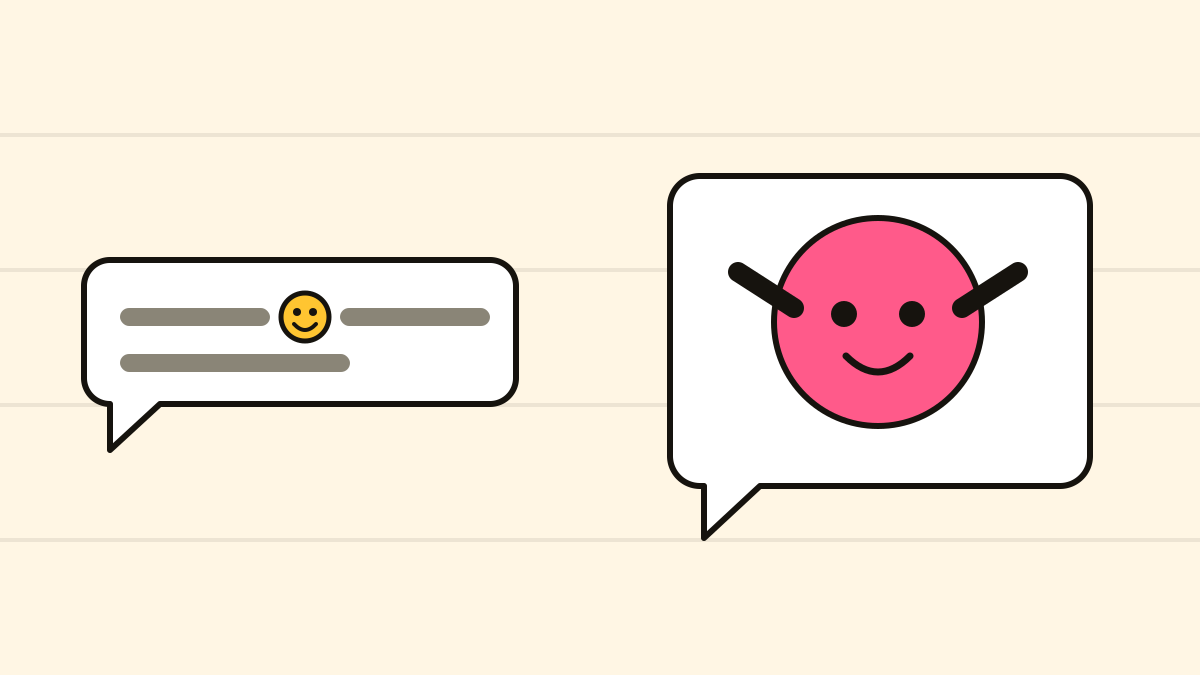
It is easy to blur the two, so let’s be precise. An emoji is a character: a fixed code point, a small picture the system slots into a line of text, drawn from a standard set (as in the last story). A sticker is a whole illustrated image — often a character with a personality, sometimes animated — that you send as its own message, filling the bubble. Emoji live in Unicode and are finite; stickers live in the app, arrive in downloadable packs, and are effectively unlimited. One is punctuation-sized; the other is a postcard.
Born in the months after a disaster
The breakout app was LINE, launched in June 2011 by NHN Japan. Its origin is bound up with tragedy: three months earlier, the Tōhoku earthquake and tsunami of March 2011 had knocked out phone networks across Japan, and people struggled to reach their families. A reliable, data-based messaging app suddenly felt essential, and LINE arrived into exactly that need.
What made LINE stick, though, were its stickers: a cast of big, expressive characters — a glum bear, a lovestruck rabbit and their friends — that let you answer a message with a feeling instead of a sentence. They became a phenomenon, then a business empire: sticker sales, then plush toys, cafés and licensing. LINE proved a startling thing to the whole industry — that people would happily pay for better ways to express themselves, and that a character sent in a chat could be worth as much as the chat itself.
The soil was already there
LINE didn’t invent this appetite; it landed in ground long prepared. Asia — and Japan especially — had a decades-deep character culture: mascots for every town, product and train line, and a kawaii (cuteness) aesthetic running back to the 1970s. From our smiley story, remember that Japan had already turned the keyboard into expressive faces with kaomoji; by the 2000s, Japanese phones had “deco-mail”, messages decorated with little images. Putting pictures into a conversation was, culturally, already normal.
So it is no surprise the idea bloomed across the region at once. In South Korea, KakaoTalk (from 2010) built its own beloved cast of sticker characters. In China, WeChat (from 2011) grew a vast sticker culture of its own, including packs made by users and artists. Three countries, three super-apps, one instinct: a message is better when it can be a picture.
The Creators Market: handing everyone the pen
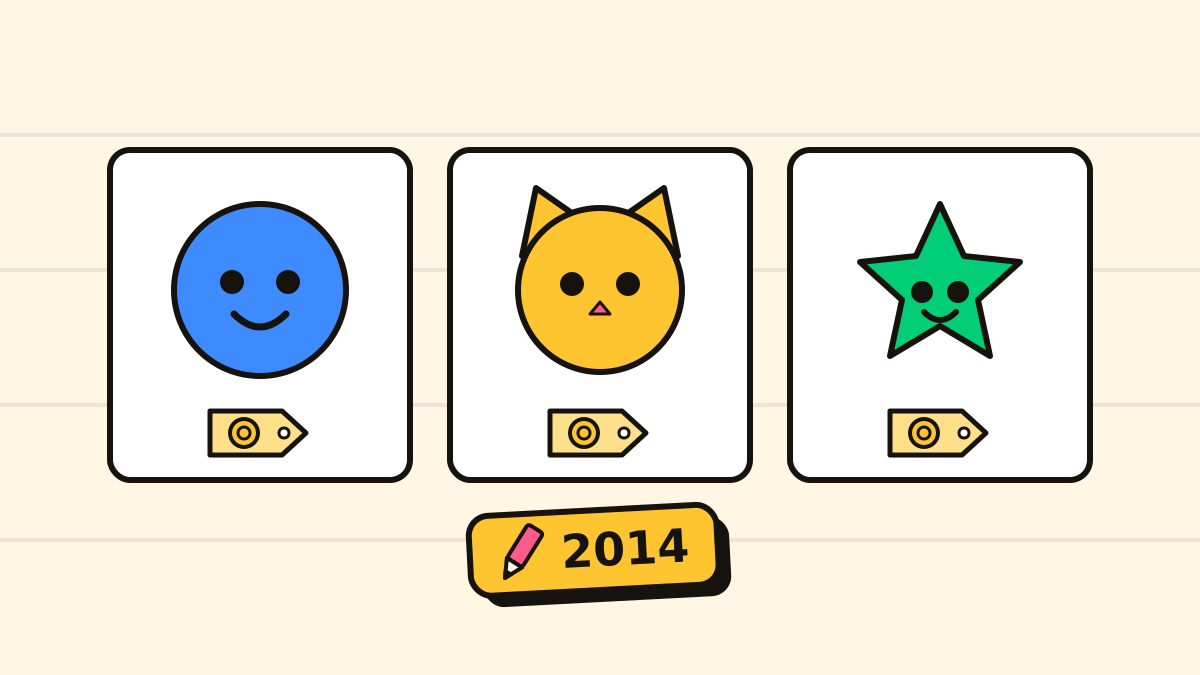
The last turn is the most important, and it echoes a pattern from earlier in this series. In May 2014, LINE opened the Creators Market: a system that let anyone draw a set of stickers, submit it and sell it, taking a share of the sales. You no longer had to be LINE’s in-house studio; you could be a student with a doodle and a good idea.
This is the LOLcat moment from our grammar story all over again — the platform handing the pen to everyone. Overnight the catalogue exploded from a company’s characters into a bottomless bazaar of them, made by tens of thousands of ordinary people. The sticker stopped being something a company gave you and became something anyone could make.
Why it mattered
Put the pieces together and you can see why the sticker is Asia’s contribution to this history. Emoji, born in Japan too, had to be small, standard and universal — a shared alphabet. The sticker went the other way: big, unstandardised, personal and commercial, a picture with a name and a price. It answered a need emoji couldn’t: not “here is a feeling from the shared set” but “here is my character saying it”.
There was just one catch, and it sets up the rest of the story. Because stickers were an app feature and not a standard like Unicode, every messaging app that wanted them had to build its own — its own packs, its own formats, its own store. For stickers to reach the rest of the world, the rest of the world’s apps would each have to reinvent them.
Asia had turned a picture into a message, and a message into a marketplace. Now the idea had to travel — to Messenger and iMessage, to Telegram and WhatsApp, to Signal and Discord — each of which would meet it in its own way, and each of which would have to decide how a sticker should be built.
Next in this series: how stickers went global — the platforms that adopted them, and the formats that carried them from a still picture to a moving one.