
Sticker stories · Part 2 · 1990 – 2000s
How did “internet meme” become a thing?
A lawyer worried about lazy arguments coined a rule in 1990 — on purpose, as an experiment in memes. Within a few years the word had jumped from biology books to the internet.
The last story ended by promising that an argument on the early internet would hand us a word for the jokes themselves. Here is that argument — and the lawyer who started it on purpose.
A rule invented on purpose
Most rules of thumb about the internet grew by themselves. This one was planted. In 1990, on the free-for-all discussion system called Usenet, a lawyer named Mike Godwin got tired of watching people reach for the laziest possible insult — comparing whoever they disagreed with to Hitler or the Nazis. So he wrote down a single line and began, deliberately, repeating it wherever the comparison came up:
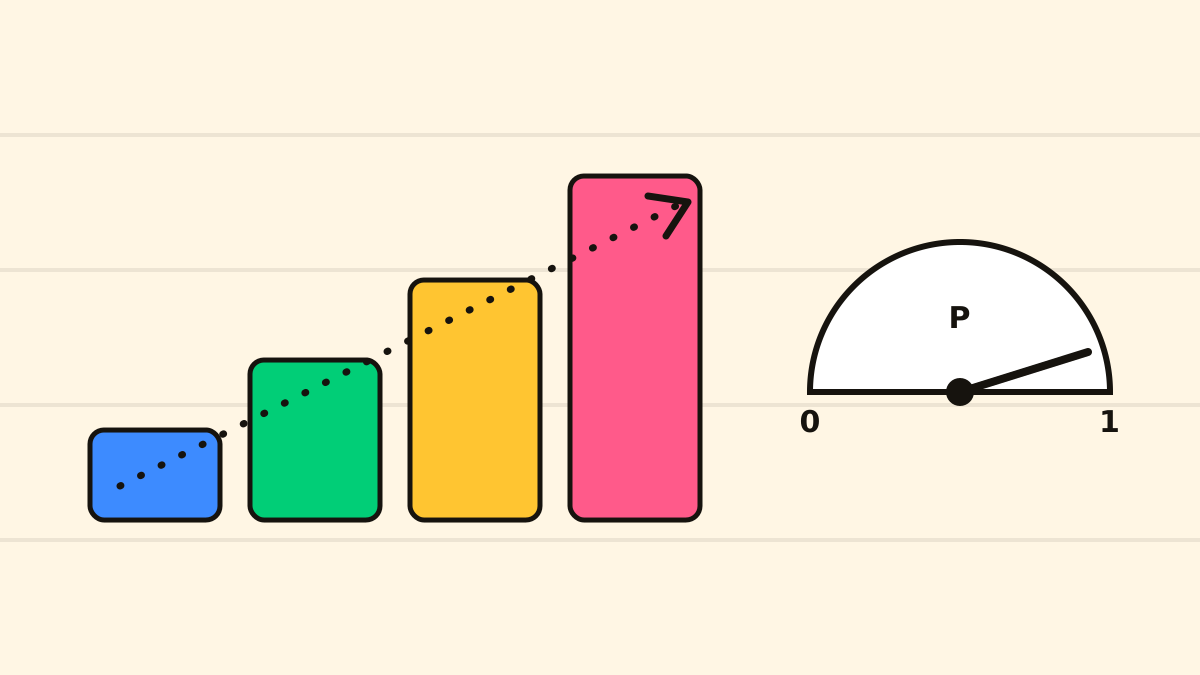
As an online discussion grows longer, the probability of a comparison involving Nazis or Hitler approaches 1.
He called it Godwin’s Law, and — this is the part that matters for our story — he has always described it as an experiment in memetics. He wasn’t only being funny. He had read Richard Dawkins, the biologist who coined meme back in our first story, and wondered whether you could fight a bad idea the way you fight a virus: by releasing a better one. If a glib Nazi comparison was a meme that spread because it was easy, then maybe a rule that made people self-conscious about reaching for it could spread too — and crowd the first one out.
The word was waiting for the net
By 1990 meme had been sitting in Dawkins’ 1976 book for fourteen years, admired but mostly academic. What it needed was a copying machine fast enough to show it off, and the early internet was exactly that. On Usenet and on e-mail mailing lists, a good line could be quoted into a reply, forwarded to a list, cross-posted to three more groups and answered by a hundred people overnight — copied, changed and selected, right in front of you, at a speed no photocopier could touch.
Academics noticed. A small field called memetics grew up around the idea; there was even a Journal of Memetics from 1997 to 2005, and Susan Blackmore’s The Meme Machine (1999) argued the case at book length. Most of that scholarship has since faded, but it did one lasting thing: it kept the word meme in circulation, attached to exactly the medium — the net — that was about to make it a household term.
Meme, counter-meme
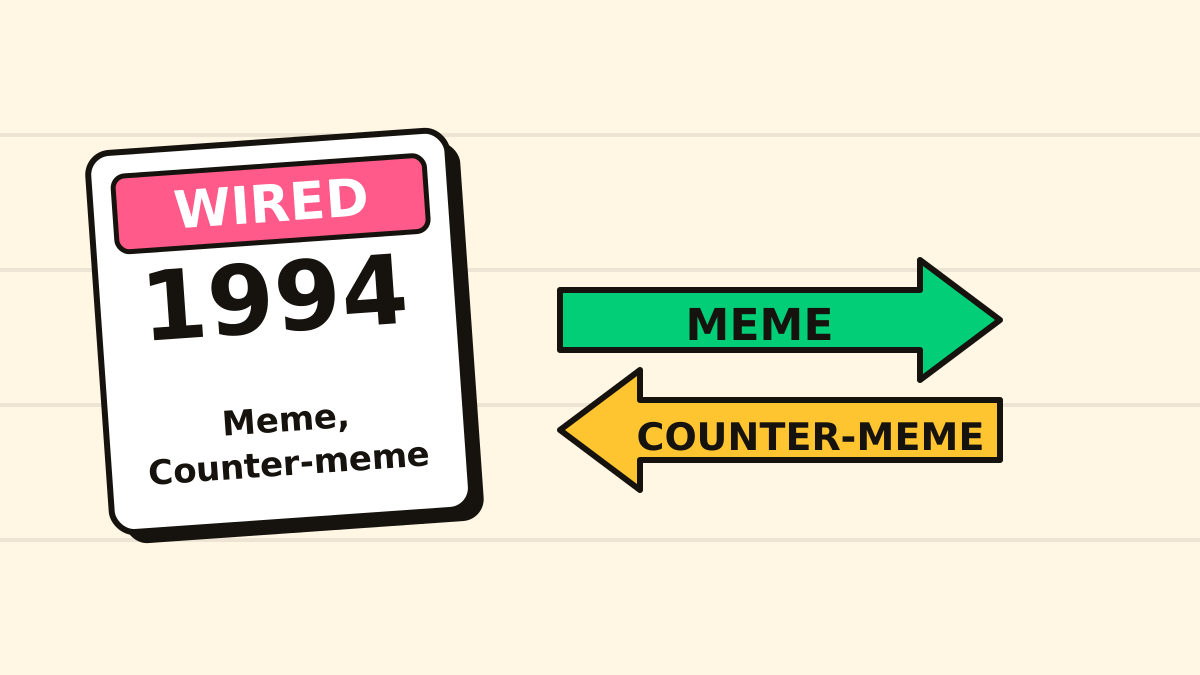
Godwin spelled the strategy out in Wired magazine in October 1994, in an essay titled Meme, Counter-meme. In it he told the story of his law, explained that he had introduced it on purpose, and made the general case: that the way to beat a harmful meme is not to censor it but to design and release a rival. It is one of the first times a wide audience saw someone treat “memes” not as a biology metaphor but as something you could do on the internet — deliberately, tactically, for effect.
That reframing is the hinge of this whole story. Once memes were things people made and launched on purpose, meme stopped meaning “a unit of cultural inheritance” and started meaning “a thing that goes around online”. The phrase “internet meme” followed close behind. Exactly when it was first written down is genuinely unsettled — some sources say 1993, others 1994 — so, as in our first story, we will just say the early 1990s and not pretend to a precision no one has.
Why the net made it stick
None of this would have caught on without the plumbing. Usenet, mailing lists and early forums were, in effect, one enormous shared copier — and unlike a wall or a photocopier, this one kept a record. You could watch a phrase mutate from thread to thread, see which version people quoted, and trace, in the archive, exactly why the catchy one won and the rest were forgotten. The three-step pattern from our earlier stories — copied, changed, selected — was suddenly happening in public, in writing, at the speed of typing.
So a word coined by a biologist, kept alive by a handful of academics and sharpened into a tactic by a lawyer, met a machine built for copying — and became the everyday word we use today.
By the mid-1990s the word was ready and the wiring was in place. All that was missing were the memes themselves — the specific, silly, wildly copied things that would prove the whole idea in public. They were about to arrive, and they would dance.
Next in this series: the first memes to truly “go viral” — a dancing baby, a looping hamster, and a broken video-game translation that took over the web.
Sources
- Mike Godwin, “Meme, Counter-meme”, Wired 2.10, October 1994
- Wikipedia — Godwin’s law
- Wikipedia — Internet meme
- Wikipedia — Memetics