
Sticker stories · Part 3 · 1997 – 2016
How were emoji born?
Emoji weren’t dreamed up by a big design studio. They started as 176 pictures, each twelve pixels square, drawn for a Japanese phone in 1999 — and then the whole world had to agree on them.
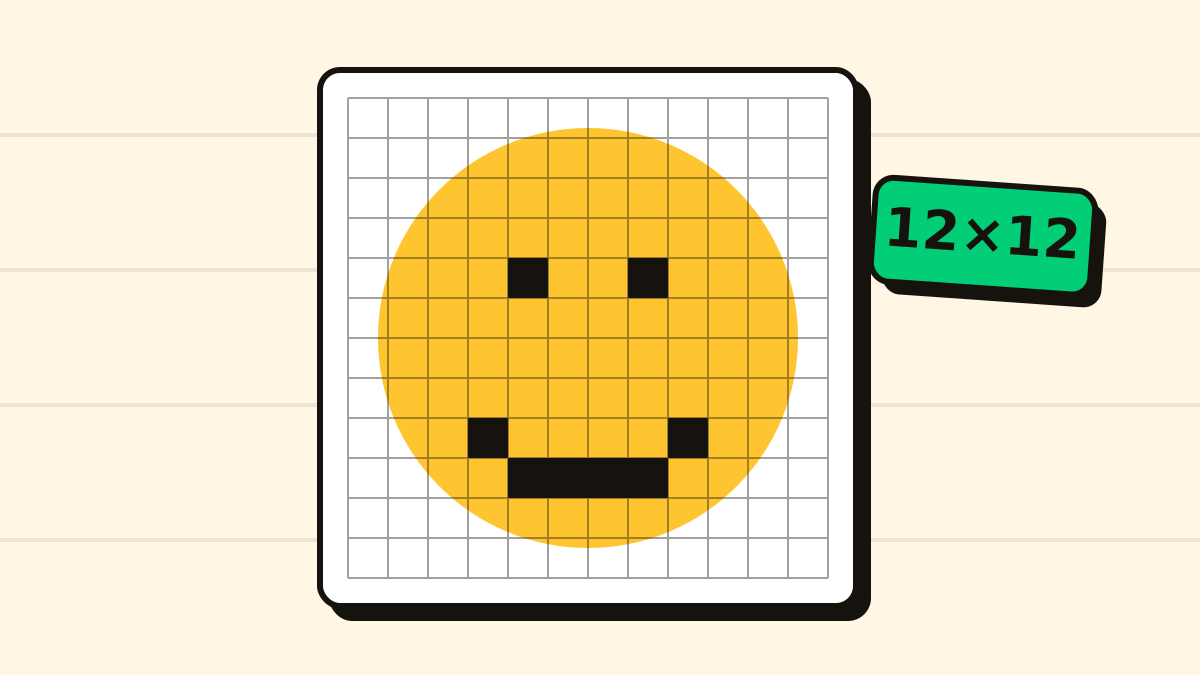
The last story ended with memes squeezing feeling into a tiny, reusable set of faces. That is exactly what a group of engineers in Japan set out to do on purpose, years earlier — except their faces had to fit in twelve pixels and travel inside a phone. This is where emoji come from, and it is a more deliberate, more Japanese and much smaller story than most people expect.
Not the same as a smiley
First, a word about the word. Emoji comes from the Japanese 絵文字 — e (picture) + moji (character). The resemblance to “emotion” and “emoticon” is a genuine coincidence; they are cousins by accident, not by name. And they really are different things. The emoticon from our earlier story is punctuation you tilt your head to read — :-). An emoji is a character in its own right, a little picture the system draws for you. One is a trick with the keys you already have; the other is a new key.
176 pictures on a Japanese phone
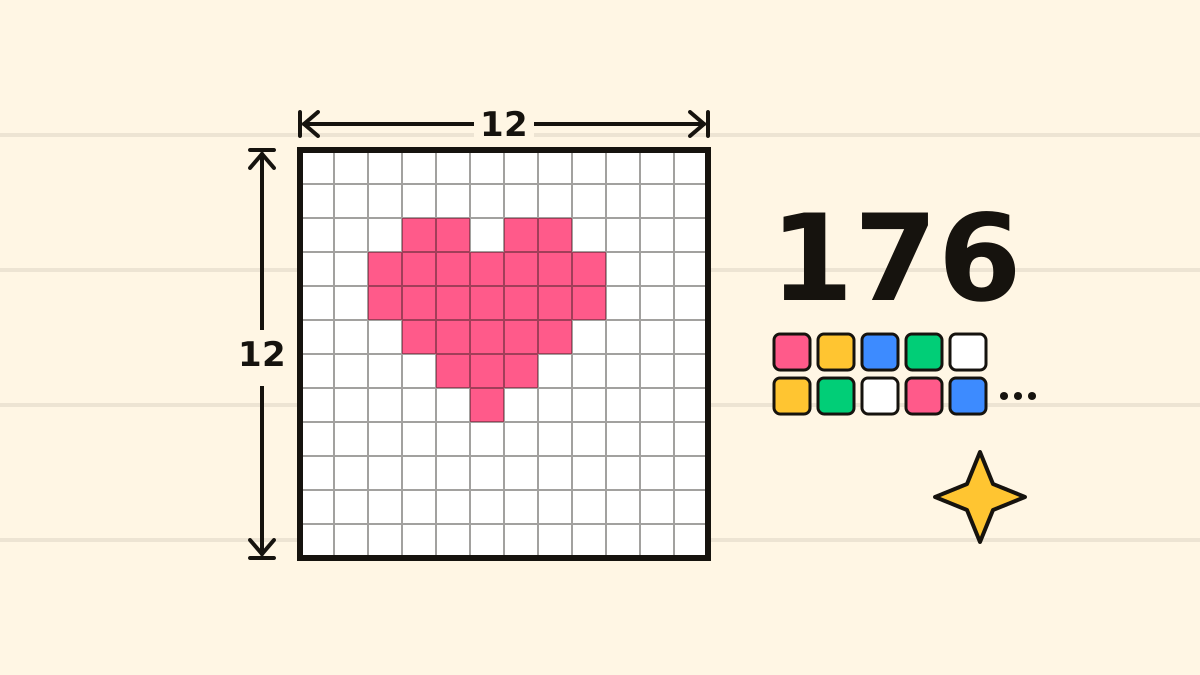
The familiar origin story belongs to Shigetaka Kurita. In 1999, working on NTT DoCoMo’s i-mode — an early mobile-internet service, years before the smartphone — Kurita designed a set of 176 emoji, each drawn on a grid just 12 pixels square. Weather, food, moods, a heart, transport: the basic furniture of a text message, so that people could say something warm in the cramped space of an early phone screen.
He was not quite first — as early as 1997 Japanese carriers were already shipping little picture sets (a SoftBank handset of that year is often cited). But Kurita’s 176 are the ones history remembers, because they were the set that caught on and set the template for everything after.
The tower-of-Babel problem
Emoji were a hit in Japan, and immediately a mess. Each carrier — DoCoMo, au, SoftBank — drew and encoded its own emoji, and they didn’t line up. Send a heart from one network to another and the receiver might get a different symbol, or a blank box. As long as emoji were each company’s private set, they could never be a universal language; they were a hundred small dialects that couldn’t understand one another.
The fix is the least glamorous and most important part of the story: emoji had to become a standard — assigned fixed, shared code numbers that every device in the world could agree on. That is the job of Unicode, the same system that gives every letter of every alphabet a universal number.
Into Unicode, onto every phone
Around 2007–2009, engineers at Google and Apple — partly so services like Gmail and the iPhone could handle Japanese emoji properly — put together a formal proposal to bring emoji into Unicode. In 2010 it happened: emoji entered the Unicode Standard, roughly 700 of them at first, each with a permanent code point every system could share.
The other half was distribution, and here Apple mattered most. The iPhone had shipped an emoji keyboard in Japan in 2008; with iOS 5 in 2011, that keyboard could be switched on anywhere in the world. Overnight, hundreds of millions of people who had never heard of i-mode had a grid of little faces one tap away. Emoji stopped being Japanese and became everyone’s.
One code, many faces
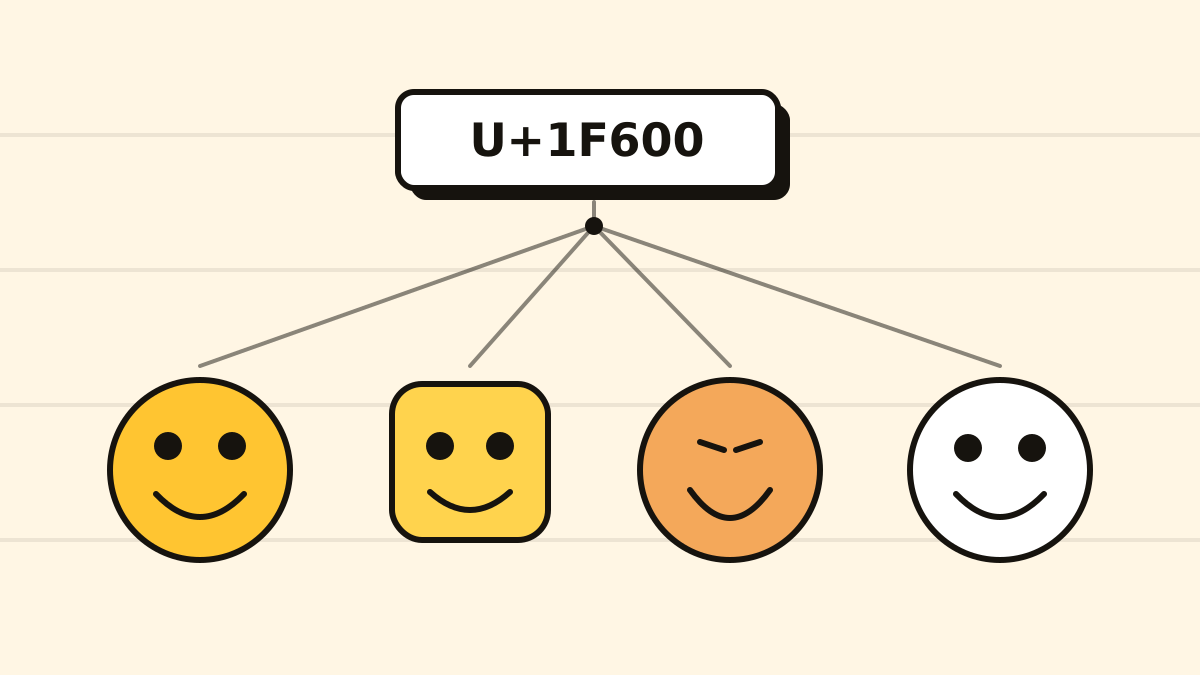
Standardising the code points did not standardise the drawings. Apple, Google, Samsung, Twitter and the rest each illustrate the same emoji in their own house style, and they quietly revise them over the years. Usually that is fine; sometimes it is not, and a face that looks friendly on one phone looks smug on another, or a picture means one thing to the sender and another to the receiver. It is the same “same word, different handwriting” problem that runs through this whole series — copied, changed, and read a little differently everywhere it lands.
Whatever the drawing, the idea proved monumental. In 2016 the Museum of Modern Art in New York acquired Kurita’s original set of 176 — the twelve-pixel pictures now sit in the same collection as the paintings. Not bad for a set of icons built to fit on a 1999 phone.
Emoji gave everyone a shared, standard, system-drawn vocabulary of feeling — but a fixed one, the same few hundred pictures for the whole planet. What if you wanted a bigger, richer, more personal picture to send: your own character, a favourite face, a whole little drawing? For that, a different idea was taking hold, and it was taking hold first in Asia. It was called the sticker.
Next in this series: why chat stickers were born in Asia — and how LINE, KakaoTalk and WeChat turned a picture into a message.