
Sticker stories · Part 2 · 1996 – 2001
The first viral memes
Before the web could reliably play a video, three things — a dancing 3D baby, a page crammed with hamsters, and a badly translated game — proved a meme could reach millions.
The last story left us with a word — “internet meme” — and a network built to copy things. What was missing were the memes themselves: specific, silly, and copied so widely that even people who had never heard the word would recognise them. Between roughly 1996 and 2001, three of them arrived. None was a photo or a slogan. One of them danced.
Before the web could play a video
It is hard to remember now, but in the mid-1990s a web page could barely show a moving image, let alone stream a clip. So the first viral memes travelled the way the chain letters in an earlier story did: by e-mail, forwarded from inbox to inbox.
The breakout was the Dancing Baby — a chubby, nappy-wearing 3D toddler doing a cha-cha. It began life in 1996 not as a joke but as a sample animation: a demo file that shipped with Character Studio, a plug-in for the 3D software 3D Studio Max, built to show off the tool’s motion features (the original figures are credited to Michael Girard and Robert Lurye). A developer named John Woodell converted the demo into a shareable clip, and it leapt out of the software world and into millions of inboxes. By 1998 it was famous enough to appear on the primetime TV drama Ally McBeal — roughly the moment a net-native meme first crossed fully into mainstream culture.
Notice the shape of it: something made for one narrow purpose, copied, repurposed and passed on until it meant something completely different from what its makers intended. That is the three-step pattern from our earlier stories, now moving at the speed of e-mail.
A page full of hamsters
The next one didn’t need e-mail at all — it lived on a single web page. In August 1998 a Canadian art student named Deidre LaCarte built a page on the free host GeoCities as part of a friendly contest with her sister and a friend over who could draw the most web traffic. Her entry was the Hampster Dance: rows upon rows of small animated rodent GIFs, wiggling and kicking in time to a looping, sped-up nine-second snip of music (a sample of “Whistle Stop” from Disney’s Robin Hood).
It sat quietly for months, then exploded in 1999 — hundreds of thousands of visits, spin-off pages, T-shirts, even a novelty single. The Hampster Dance showed that the web page itself could be the meme: not a file you forwarded, but a place you sent people to, that copied itself as links instead of attachments. (The deliberate misspelling “hampster” is part of the charm — and, like the mangled spelling of LOLcats later, part of why it felt like an in-joke.)
All your base
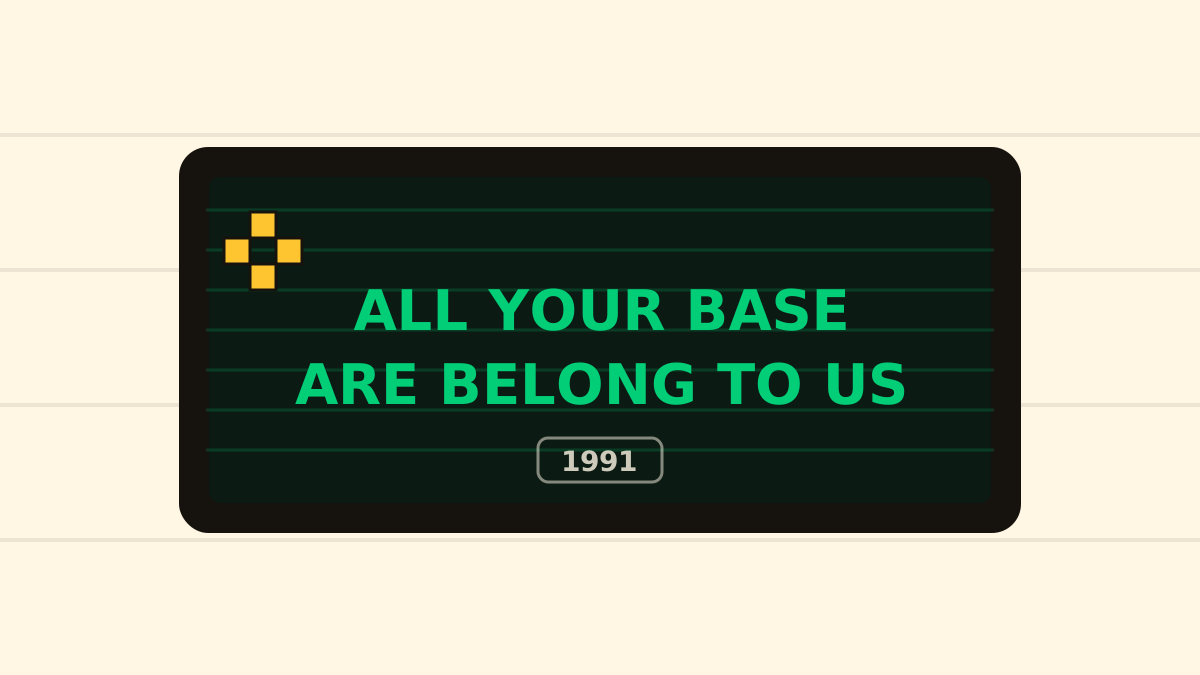
The third came from an unlikely place: a 1989 arcade shoot-’em-up called Zero Wing, made by the Japanese studio Toaplan. When it was ported to the Sega Mega Drive in 1991, someone added an opening cut-scene with a hurried, almost word-salad English translation. The villain announces: “All your base are belong to us.” Elsewhere: “Somebody set up us the bomb,” and “You have no chance to survive make your time.”
For years it was just a curiosity traded among gamers. Then, around 2000–2001, the forums — Something Awful chief among them — turned it into a full-blown phenomenon: hundreds of image macros pasting the phrase onto signs, cereal boxes and billboards, plus a much-shared Flash animation set to a remix. “All your base” is a milestone in this history because it was participatory: the meme wasn’t one image but a template — a phrase people applied to a thousand new pictures. That is the direct ancestor of the image-macro era still to come.
What made these the first “viral”
Chain letters and xeroxlore had reached a lot of people before, slowly. What was new here was reach plus speed plus reach again: e-mail and the early web could carry a moving, sound-making thing to millions of strangers in weeks, and — crucially — let each of them make and re-share their own version. The Dancing Baby proved a meme could be a video; the Hampster Dance proved it could be a place; “All your base” proved it could be a template anyone could fill in.
They also share one technical thread that ties this whole middle stretch of the story together: nearly all of them moved as GIFs — the humble little image format that could hold a few frames of animation and loop forever. It is such an important character in the life of memes that it deserves a story of its own.
Each of these lived and moved as a loop of a few frames — the format that made web animation possible when everything else on the page was still a still. To understand the memes that followed, you have to understand that format.
Next in this series: the life of the GIF — where it came from, why it loops, and how a 1980s file format became the native tongue of internet reactions.